

The Moon Landing and the Nazis
Explore
The Moon Landing and the Nazis
Explore
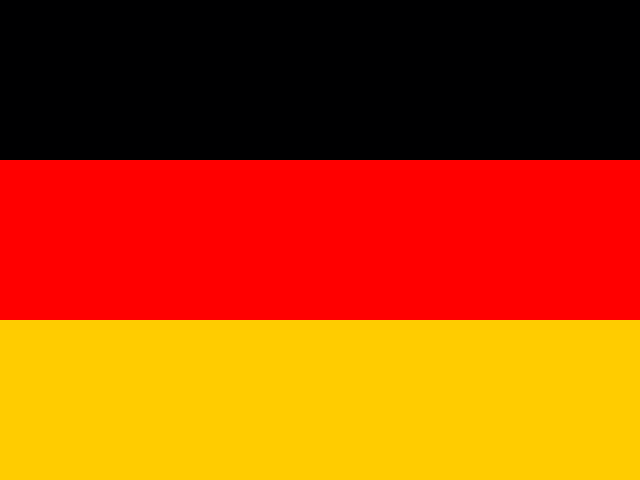
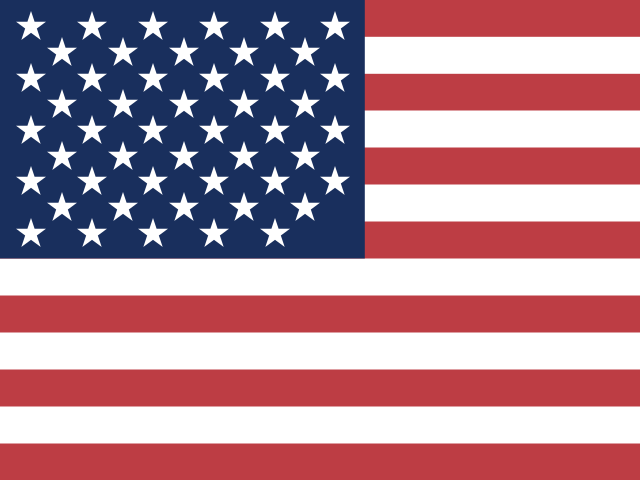
The film "The Moon Landing and the Nazis" documents the involvement of German NASA employees with the Third Reich.
28 de set. de 2026
Horários em Europe/London
Programação arquivada deste dia. O player abre a transmissão ao vivo.
The film "The Moon Landing and the Nazis" documents the involvement of German NASA employees with the Third Reich.
The first programme features four bunkers built before World War Two. We begin with the legendary Franzensfeste in today’s northern Italy, a fortress that was never besieged.
The second programme features shelters in the nuclear era in Lithuania, Germany and Albania.
The documentary addresses the counterfactual question of a Nazi victory in the Second World War and is asking at the same time how history would have evolved without Hitler.
In the waters surrounding New Zealand live a number of dolphin species - each of which has evolved unique strategies in their family pods to survive and thrive in the different habitats around these islands in the Pacific Ocean. On the east coast of the south island off the iconic Kaikoura peninsula
Eagles are top predators who battle fiercely for survival and work hard to raise their young. There are 60 members of the eagle clan, all united by their acute eyesight, powerful wings, sharp talons and hooked beaks. To explore the world of the eagle we follow one individual from hatching to leaving
The Lauenburg Lake District is located between Lübeck and Lauenburg on the River Elbe. With more than 470 square kilometres, it is the third largest natural reserve in Schleswig-Holstein. Due to its extensive forest areas, 40 lakes and its proximity to Mecklenburg’s biosphere reserve Lake Schalsee,
Anacondas have fired people's imagination since time immemorial. Hardly any other animal is so feared and yet at the same time so revered as the biggest snake in the world.
The gallery forests of the Serengeti are the realm of a phantom. The shadowy thickets are the domain of a Leopardess.
A brook in the Serengeti is the home of a leopardess. The secret queen of the shadows took care of her son and has done a good job so far but the adventure continues.
Human life today would be very different if our ancestors had not stopped hunting animal protein. In the Fertile Crescent - known today as the Middle East - humans travelled in nomadic groups of hunter-gatherers and ate what they killed.
When our ancestors saw how other animals kept warm in sub-freezing temperatures, they started hunting them for their hides and fur. As hominid evolution was diverging from other primates, they lost their thick covering of fur when the mercury dropped.
About twelve thousand years ago, before the Neolithic Revolution, humans were mainly hunter-gatherers. Among the animals we hunted were the wild aurochs, the ancestor of all domestic cattle. The domestication of cows led to the use of oxen as draught animals that could help farmers plough fields.
Throughout history, humans have surrounded themselves with animals. But there are two species that are our undeniable favourites. Every dog today was once a wolf - genetically speaking. Wolves and hominids met as early as 400,000 years ago. Ancient hunter-gatherers and wolves competed for the same p
The world is full of giants, huge creatures that fill us with awe and wonder. Some are gentle giants. Others are deadly hunters. There are different ways of defining ‘big’ - biggest in volume, or the biggest of their kind. But one thing is for sure, the huge animals of this world are fascinating, di
We mostly know the nimble predators from the depths of tropical seas. At the same time very little is known about the sharks of the icy North.
For most of our history, people have fallen victim to crippling disease, and not had a clue where it came from. Despite our best efforts, we are vulnerable - not, perhaps, to lions, tigers, and bears - but more to the killers we can’t even see. In America during the early 1980s, a mysterious new dis
As a species, we believe we are more than just animals. We are inspired to express ourselves through words, art, music, and scientific endeavours. Our ancestors painted animals on cave walls - usually large mammals, like bison and deer. Animals were out first artistic subject, our first inspiration.
Europe's history has many dark sides, but its culture is more than a small gleam of hope, it radiates in many areas far out into the world. The old continent sets standards in art, literature and science. Starting with the ancient Greeks, Europe produces a number of smart and creative minds: from Ar
Europe has been a battle concept for centuries: it often takes foreign enemies to weld the Europeans together. But for centuries, they are primarily fighting against themselves. It was not until the Enlightenment and the French Revolution of 1789 that a new idea of Europe emerged based on common val
Europe has never experienced such a long period of peace and prosperity as after the Second World War. When the Iron Curtain falls in 1989, the dream of a Europe united in peace and freedom seems finally to become reality. But whether financial or refugee crisis - the European euphoria has disappear
Sex is at the heart of everything. It’s the only real way of leaving a legacy - in the genes of the future. But there’s more than just the act - it’s the build up to it when wildlife shows its incredible diversity. It drives touching courtships and fierce battles. Hormones and sex drive are forces t
In the waters surrounding New Zealand live a number of dolphin species - each of which has evolved unique strategies in their family pods to survive and thrive in the different habitats around these islands in the Pacific Ocean. On the east coast of the south island off the iconic Kaikoura peninsula
Eagles are top predators who battle fiercely for survival and work hard to raise their young. There are 60 members of the eagle clan, all united by their acute eyesight, powerful wings, sharp talons and hooked beaks. To explore the world of the eagle we follow one individual from hatching to leaving
The Lauenburg Lake District is located between Lübeck and Lauenburg on the River Elbe. With more than 470 square kilometres, it is the third largest natural reserve in Schleswig-Holstein. Due to its extensive forest areas, 40 lakes and its proximity to Mecklenburg’s biosphere reserve Lake Schalsee,